I have been admittedly absent from this page for a while–first, I was swamped with media relations work related to impactful COVID-19 research conducted by my institute, and then, we immediately launched into a year-long campaign to mark the institute’s 25-year anniversary. Add schoolwork to these responsibilities, and I have let my personal portfolio languish.
However, I am learning and producing so much cool stuff in my graduate program that I hope to revive this blog space so I can share some projects that are outside of my normal wheelhouse. It’s great to feel my skill set expanding in real time.
First, I wanted to reflect on what we’ve done so far for the campaign I mentioned above. It’s been a whirlwind, but it has also been a lot of fun and has taught me a lot about the history of where I work. Here are the broad phases this campaign has undergone, and my contributions to each.
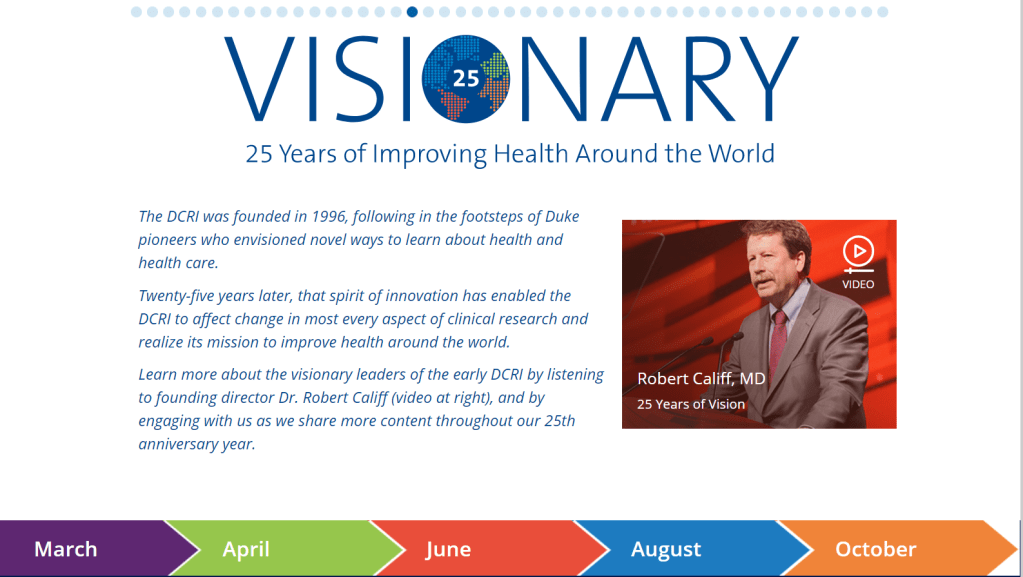
Ideation/Strategy Setting/Concept Development. When my small team of three initially sat down to brainstorm, it felt as if we faced a herculean task–to come up with a communications plan to celebrate 25 years of the DCRI. I felt strongly that we needed a solid foundation to tie this campaign to in an effort to narrow our focus, and I put forth the idea that we align the campaign content with the institute’s new vision statement. After meetings with both internal and external stakeholders, this idea was accepted and we began to plan in earnest.
Content Development. Our campaign consists of five major content releases phased every two months throughout the year, which meant a lot of upfront planning to ensure there was no overlap and that every corner of the institute was fairly and equally represented. This also required a lot of input from both internal and external stakeholders, and we had to be fairly adaptable as plans shifted (sometimes mid-campaign, once we’d already started on execution).
Execution. Our campaign is centered on video content, and I am tasked with the execution of these videos. which I love because I get to interview a lot of interesting people and hear their perspectives directly. However, execution of this was complicated by the COVID-19 pandemic. So far, all of our videos have been recorded via Zoom, which has required a whole new set of learnings regarding lighting, audio, editing, etc. While not an ideal setup, we’ve still produced some really impactful and inspiring content. I work closely with our video editor, providing him the storyboard and time codes to tell a story that will resonate. Side note: While working on this campaign, I had the opportunity to learn Adobe Premiere Pro in school, which gave me an entirely new respect for how quickly and efficiently he works!
Dissemination. As the manager of DCRI’s social media channels, I am also responsible for creating and scheduling social media packages to accompany each content release. These packages include video snippets, impactful quotes, and social media graphics that a colleague helps me to design. In keeping with our theme of “Visionary: 25 Years of Improving Health Around the World,” I developed the hashtag #25YearsOfVision, which is now used for this campaign across Twitter, LinkedIn, and Facebook.
Analysis–and Adaptation. While I do keep an eye on our day-to-day social analytics, I don’t have a formal analysis capacity in my current role. My colleagues report back to me, and we respond as necessary by tweaking our strategy. For example, we recently found that the videos were performing much better in their shorter forms on social media than they were on the campaign landing page. Because of this, we will change the format of the next content release to mirror shorter, more digestible video content.

 Kaitlin Jansen